




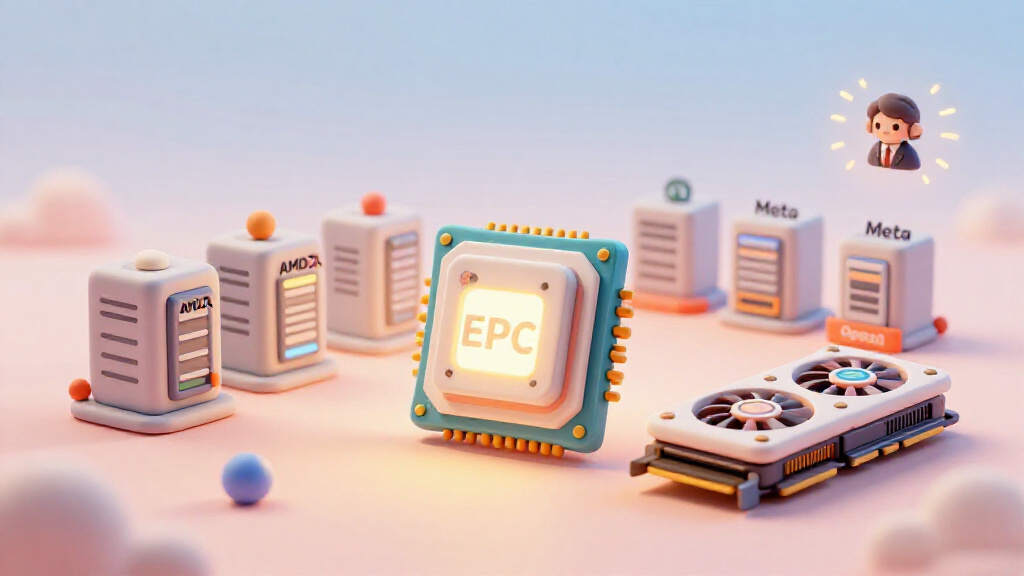
AMD's data center segment saw revenue double to $6.7 billion in Q2 2026, driven by its AI-powered chips, including Instinct MI350 GPUs and EPYC Venice CPUs. The company's data center business now accounts for 58% of its total revenue. AMD also introduced Helios, a rack-scale AI system, and announced partnerships with Meta and OpenAI.
Nvidia is countering AMD's AI advances with its larger balance sheet and resources, according to former AMD executive Patrick Moorhead. Nvidia has announced partnerships to establish financing platforms for AI factories and data centers, aiming to mobilize over $500 billion in third-party capital.
The AI Trust and Security Consortium (AITSC) has launched applications for its founding cohort of enterprise security and technology leaders. The consortium aims to create AI guardrails and provide a platform for security leaders to share knowledge and best practices.
Several companies, including Nebius and CoreWeave, have reported better-than-expected quarterly revenue driven by growing demand for AI solutions. Nebius reported revenue of $114.3 million for the quarter ended March 31. Alibaba released the open weights for its Qwen3.8-2.4T-A95B AI model, bringing near-frontier capabilities to the open ecosystem.
Meta has rolled out a new 30-billion-parameter AI model optimized to run on a PC or Mac with a single GPU, offering a way to run always-on agentic workflows locally rather than relying on the cloud. The model, called Muse Glimmer, requires a GPU with a minimum of 24GB of VRAM. Meanwhile, a recent vulnerability in Zoom's annotation feature highlights that you don't need the most powerful AI models to cause major cybersecurity incidents.
Key Takeaways
• AMD's data center revenue doubles to $6.7 billion in Q2 2026, driven by AI-powered chips. • Nvidia counters AMD's AI advances with larger balance sheet and resources. • AI Trust and Security Consortium launches to create AI guardrails. • Nebius reports better-than-expected quarterly revenue driven by AI demand. • Alibaba releases open weights for Qwen3.8-2.4T-A95B AI model. • Meta rolls out new 30-billion-parameter AI model optimized for local use. • Zoom vulnerability highlights cybersecurity risks with less powerful AI models. • CoreWeave and Nebius earnings boost AI trade. • MPWR's AI and server demand lifts earnings and estimates. • Omaha small businesses can apply for Breakthrough 402 AI training program.AMD's Data Center Revenue Doubles with AI-Powered Chips
AMD's data center segment reached $6.7 billion in Q2 2026, up 107% year-over-year, driven by Instinct MI350 GPUs and EPYC Venice CPUs. The company introduced Helios, a rack-scale AI system, and announced partnerships with Meta and OpenAI. AMD's data center business now accounts for 58% of its total revenue. The company's AI strategy includes a four-layer structure covering data center CPUs, GPUs, rack-scale systems, and open-source software infrastructure.
Ex-AMD Exec Warns of Nvidia's AI Tactics
Former AMD executive Patrick Moorhead says Nvidia is using its larger balance sheet and resources to counter AMD's AI advances. Moorhead compares the situation to AMD's historic fight against Intel, where Intel would expand its offerings and vertically integrate new technologies. Nvidia has announced partnerships to establish financing platforms for AI factories and data centers, aiming to mobilize over $500 billion in third-party capital.
AI Trust and Security Consortium Launches
The AI Trust and Security Consortium (AITSC) has opened applications for its founding cohort of 50 enterprise security and technology leaders to define how AI gets deployed, governed, and trusted inside large organizations. The consortium aims to create AI guardrails and provide a platform for security leaders to share knowledge and best practices. AITSC will publish reference architectures, control frameworks, and governance models.
AllenAI Open Instruct Tulu 3 Post-Training with SFT, DPO, RLVR, GRPO, and Verifier-Based Evaluation
AllenAI implemented a miniature version of the Tulu 3 post-training stack and observed how each training stage changes model performance on verifier-scored mathematical reasoning tasks. The company used various techniques such as supervised fine-tuning, length-normalized DPO, and group-relative advantages.
Omaha Small Businesses Can Apply for AI Training Program
Omaha small businesses can apply for the Breakthrough 402 AI training program to learn how to use AI for marketing, customer outreach, and more. The program is designed to turn AI from a buzzword into a practical tool, helping entrepreneurs create marketing content, follow up with customers, and build an AI assistant trained on their own business.
Nebius Beats Quarterly Revenue Estimates with AI Demand
Nebius reported better-than-expected quarterly revenue, driven by growing demand for its AI solutions across various industries. The company's revenue for the quarter ended March 31 came in at $114.3 million, surpassing analysts' estimates.
Should Investors Buy MPWR as AI Growth Meets Premium Valuation?
MPWR's AI and server demand is lifting earnings and estimates, but a 44.1X forward multiple and limited margin expansion raise the bar for investors. The company's AI and server demand is expected to continue growing, but the premium valuation may be a concern for investors.
Alibaba Releases Qwen3.8-2.4T-A95B AI Model
Alibaba released the open weights for Qwen3.8-2.4T-A95B (Qwen3.8-Max), its largest open-weight model, bringing near-frontier capabilities to the open ecosystem. The model has 2.4T total parameters with 95B activated per token.
CoreWeave and Nebius Earnings Boost AI Trade
CoreWeave and Nebius, two AI hardware makers, reported their latest results, and the numbers are breathing life into the markets. The companies' earnings reports are closely watched by investors, and the AI trade has been a key driver of the market's performance in recent months.
Meta's New Local Model Forces Enterprises to Recalculate AI Costs
Meta rolled out a new 30-billion-parameter AI model optimized to run on a PC or Mac with a single GPU, offering a way to run always-on agentic workflows locally rather than relying on the cloud. The model, called Muse Glimmer, requires a GPU with a minimum of 24GB of VRAM.
You Don't Need Powerful AI Models to Cause Cybersecurity Incidents
A recent vulnerability in Zoom's annotation feature highlights that you don't need the most powerful AI models to cause major cybersecurity incidents. The vulnerability was present in every version of Zoom on every operating system and was exploitable in calls with end-to-end encryption.
Sources
- AMD Data Center Revenue Doubles: Lisa Su's Four-Layer AI Portfolio
- Ex-AMD Exec Says Nvidia Is Using Its Bigger War Chest To Counter AI Gains: ‘I Experienced This Same Play’ Against Intel
- AI Trust and Security Consortium Launches to Set Peer-Defined Standards for Enterprise AI
- AllenAI Open Instruct Tulu 3 Post-Training with SFT, DPO, RLVR, GRPO, and Verifier-Based Evaluation
- Omaha small businesses can apply for AI training program to boost marketing and growth
- Nebius beats quarterly revenue estimates as AI demand fuels growth
- Should Investors Buy MPWR as AI Growth Meets a Premium Valuation?
- Serve Qwen3.8-2.4T-A95B, a 2.4T-Parameter Model, with Configurable Reasoning on NVIDIA GB300 NVL72
- CoreWeave, Nebius earnings breathe life into the markets AI trade
- Meta’s new local model forces enterprises to recalculate AI costs and ROI
- Turns Out You Don't Need The Most Powerful AI Models to Cause a Major Cybersecurity Incident
Comments
Please log in to post a comment.